Tuesday, December 14, 2010

Young, Restless, Reformed

In this journalistic book by Collin Hansen, editor-at-large for Christianity Today, it outlines the New Calvinist movement over the last 20 years or so. This movement, which is really a return to old Reformed thought and doctrine than to any new beliefs, has been on the move in some amazing ways. This brief history offers an inside look at what some of the leading pastors, churches and conferences are saying from a movement that was even ranked #3 among Time's top emerging ideas changing the world in 2009, seen here.

I was originally attracted to this book from the introduction on Amazon, which talked about the authors roots with Campus Crusade for Christ at Northwestern University. Just 6 years after Hansen first found himself in this movement, I was first introduced to it a couple hours south at the University of Illinois' Crusade ministry. With topics like God's sovereignty, predestination, and irresistible grace at the forefront of many conversations being had by Christians in these two Illinois campuses, many students don't know this is an expanding movement, reaching much farther than their campus grounds. Hansen's book was personally enjoyable for me to get insight into a belief system that in some ways I've been a part of for 6 years now, since entering the U of I in 2005. (This is not to say that Campus Crusade is explicitly or exclusively Calvinist in its confession of faith by any means.)

Overall, the book presented good overview and insight into New Calvinism. It is made up of two years worth of interviews from leading Reformers, such as John Piper, Albert Mohler, C.J Mahaney, and Mark Driscoll, who, for followers, have become household names.

These leaders, and many others, don't all believe the same things about things like baptism and worship styles, but they do share a common passion for spreading the glory of God. They would continue that God is most glorified when He gives us a relationship with Him through His Son, Jesus Christ. Furthermore, we can give God praise after praise because He saw us in our sinful deadness and found it within Himself to reach out to us in our sin, granting us faith and salvation. Because of God's doing, by nothing we have done, we are no longer dead in sin, but alive in Christ.

This is not a book to be read for its conclusions, as not many are drawn. It is more pointed at documenting a unique and developing aspect of church history. New Calvinism is a movement worth learning about whether you are fully involved, partially partaking, or not a part of it at all. And, watch out! It might find you and call you into belief, if you aren't careful; that is, if God providentially ordains it!

I would recommend this book, especially for those interested in church history.

"Church History" (3.5 of 5 STARS)

Tuesday, November 23, 2010

Why We Love the Church: In Praise of Institutions and Organized Religion

Continuing on my Kevin DeYoung kick, I recently read Why We Love the Church, his 2nd co-authored book with Ted Kluck in response to the Emergent church movement. The first of which was Why We're Not Emergent: By Two Guys Who Should Be. I have come to really respect DeYoung; he is a well thought out, well researched, Christ-centered writer. He is readable, respectful, and can make just about any topic interesting. Case in point: The two books I've read of his have been about decision making and church institutions.

But, enough about DeYoung, let's get to the book. This is much more a response to the faulty, unbiblical teaching of Emergent Christianity, than it is anything else. It delves into why books like Revolution by George Barna, Life After Church by Brian Sanders, and even a book called The Gospel According to Starbucks by Leonard Sweet are off-base and out of touch with God's true desire for Christian community and His bride, the Church. The essence of the Emergent movement is that the church (small c) is old, stale and irrelevant. Leaders even go as far as to say, Jesus' true desire for His Church (big c) is that they experience Him in real community--often small group, house church community or golf course community--outside of the church building. They would rather drink coffee at Starbucks and talk vaguely about God, than step foot in a institution with rules and regulations. To them, going to a church building is all bad and stepping out into a small community of Christian believers with no real structure is all good.

The two authors, DeYoung, the lead pastor of a church in East Lansing Michigan, and Kluck, a church laymen and sports writer, spend most of their time deconstructing the life-after-the-church mindset, warning of the dangers and presenting clear Biblical evidence for why Jesus does in fact like the "boring" parts of church--the institution, structure and hierarchy. They admit the church is not a perfect organism, but frankly, it is made up of all sinners and it will, therefore, have lots of room to grow into a more Christ-like thing. They contend the church does a lot of good and give many examples of this.

As for my opinion, I found this to be a worthwhile read. I didn't expect it to be such a drawn out critique on the Emergent movement, as I thought that was what their first book was about, but I did find it to be pertinent to a culture that looks for the easy way out (read: let's go hiking and talk about God's creation, rather than sit in a pew and sing the same old worship set). I think they boldly, yet tactfully, made their point. I leave you with one of their concluding thoughts that I liked:

"It's easy for the church to be blind to her failings. But it's also easy and borderline slanderous to constantly berate the church for all her failures as if she cared for no one, helped no one, and made no difference for anyone anywhere." (page 222)

"Church Doctrine" (3.5 of 5 STARS)

- ae

Wednesday, October 20, 2010

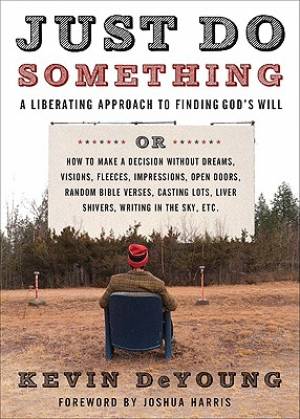
Just Do Something: A Liberating Approach to Finding God's Will

I thought I would finally write a review on the book I've been quite obsessed with the last 2 months. In fact, to give you an idea of how obsessed I have been, I have been going through this book in discipleship with six of my guys, along with doing a seminar based upon it at U of I Cru's Fall Getaway, among many other plugs to anyone that will listen to me :-)

The main thrust of DeYoung's book on Godly decision-making is that God cares much more about how we make a decision and much less about what our decision ends up being. The catch is, if our decision involves sin or sinful motives, by no means is that where God's will would have you go. God cares most that we love Him and walk with Him, living daily by going to the cross of Jesus, worshiping Him for who He is and for saving us from our sinfulness, raising us into a righteous standing before a perfect God. If we are doing this, which very much involves seeking Him, we are free to make choices in our lives.

According to the author, God is not going to give you a "yes" or a "no" answer for the everyday decisions we face. The same goes for big decisions in our lives, such as who we marry, what career to take, and when to buy a house or have children. The key here is that God promises to lead us by the Holy Spirit as Christians, but He never promises to give direct answers. Moreover, there is not a corn maze for us to track down God's will for our lives. His will and what He most desires is that we walk a life devoted to Christ. As for where he wills us to go directionally, he doesn't so much care. Now, of course, the God of the Universe cares for us, but at the end of the day, if you are not in sin, walking in manner worthy of His calling, he doesn't care what you choose.

Isn't that refreshing?!?! Personally, I think this is the biggest insight of the entire book and it is truly liberating, as the subtitle tells us the book will be! Our lives do not have to be an exhausting search for God's will for our lives. He doesn't have a hidden path, filled with secret Bible verses, that he expects us to miraculously discover.

I would highly recommend this short read for everyone out their that faces decisions, which means you! It is a quick, engaging read that you will not be able to put down.

"Christian Living/Practical Life/Decision Making" (5 of 5 STARS)